
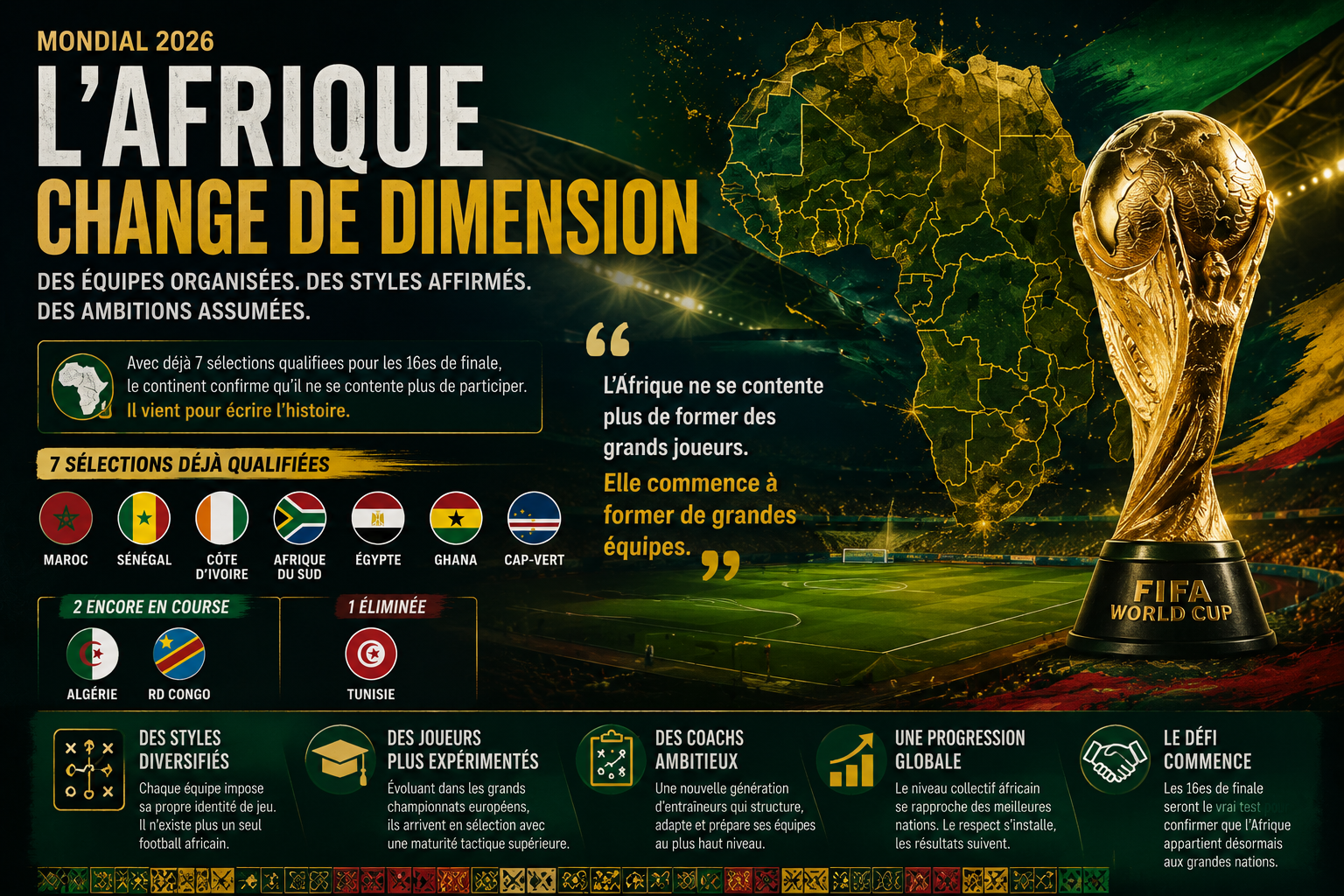
A vast continent, capable of producing some of the best players in the world, but rarely teams able to establish themselves durably among the great powers. For decades, African football has lived with this paradox. This 2026 World Cup, however, seems to be telling a different story. What if Africa were no longer simply a reservoir of talent, but now a continent of great teams?
A progression that cannot be explained by the new format alone
The first argument put forward to put African performances into perspective is often the same: the World Cup now welcomes 48 teams instead of 32. Mathematically, more African representatives therefore had a greater chance of reaching the knockout stages. The reasoning is logical — but it is also incomplete.
For an extra place offers no guarantee of qualification. One still needs to be capable of competing with the best nations. Yet, since the start of the tournament, several African sides have not merely held their own: they have played attractive football, imposed their rhythm, and at times dominated teams historically far more experienced.
The expansion of the tournament opened a door. Africa's teams chose to walk through it.
There is no longer one African football, but many African footballs
For a long time, observers spoke of "African football" as a uniform bloc: physical, fast, instinctive. This vision increasingly belongs to the past. The sides present at this World Cup illustrate an unprecedented tactical diversity.
- Morocco patiently builds its attacks, manages the quieter periods of play and relies on a tactical organisation that ranks among the most refined in the tournament.
- Senegal, under Pape Thiaw, is gradually seeking to become a possession-based side capable of imposing its game, even if this evolution is still accompanied by some defensive imbalances.
- South Africa favours short combinations, technical control and intelligent occupation of space.
- Ivory Coast remains faithful to a more vertical approach, built on physical power and rapid transitions.
- Cape Verde built their feat on remarkable collective discipline, sometimes accepting to suffer without ever losing their shape.
There is therefore no longer a single African identity. There are now several African schools of play. That is probably the greatest evolution of this generation.
Coaches who fully embrace a genuine identity
This evolution does not concern the players alone. It is also one of the coaches. For a long time, African national teams were judged on their ability to defend, run and exploit the individual qualities of their stars. Today, coaches speak of structures, balance, pressing, playing out from the back and occupation of half-spaces.
African football no longer imitates. It adapts. Each national team is progressively developing its own identity according to its squad, and this tactical diversity is undoubtedly one of the most profound changes of recent years.
Players who arrive with a different tactical culture
The leaders of the major African national teams now play in the best European leagues — the Premier League, La Liga, Bundesliga, Serie A. They work week in, week out with some of the best coaches in the world, master several tactical systems and understand in-game tactical adjustments.
This experience is now reflected at international level. The gap that once separated the great European nations from African teams is gradually beginning to close.
The next challenge: turning promise into historic runs
The group stage represents a first step. The hardest part begins now. For a World Cup is not judged solely by the number of teams that qualify, but by the ability to beat the best sides when every detail becomes decisive.
Morocco will need to confirm their new status. Senegal will need to show that their tactical evolution is sufficiently developed to compete with the great nations. Ivory Coast will need to sustain the momentum born from their continental triumph. South Africa, Ghana, Egypt and Cape Verde will also have the opportunity to write a new page in their history.
FootCorner's take
For a long time, African football lived with a form of injustice: its players shone at the world's greatest clubs, but their national teams struggled to convert that potential into lasting results on the world stage.
This World Cup seems to be telling a different story. A story in which African teams no longer win simply through an individual moment of brilliance or a perfectly executed counter-attack, but because they are organised, because they possess an identity, because they know how to adapt their game plan to their opponent.
Perhaps the most telling symbol is right here. Today, when a draw names an African side as an opponent, the great nations no longer speak of a potential banana skin. They speak of a real challenge. And that may be African football's greatest victory of all.
For respect is not proclaimed. It is earned.

Comments
By posting, you agree to our privacy policy.