
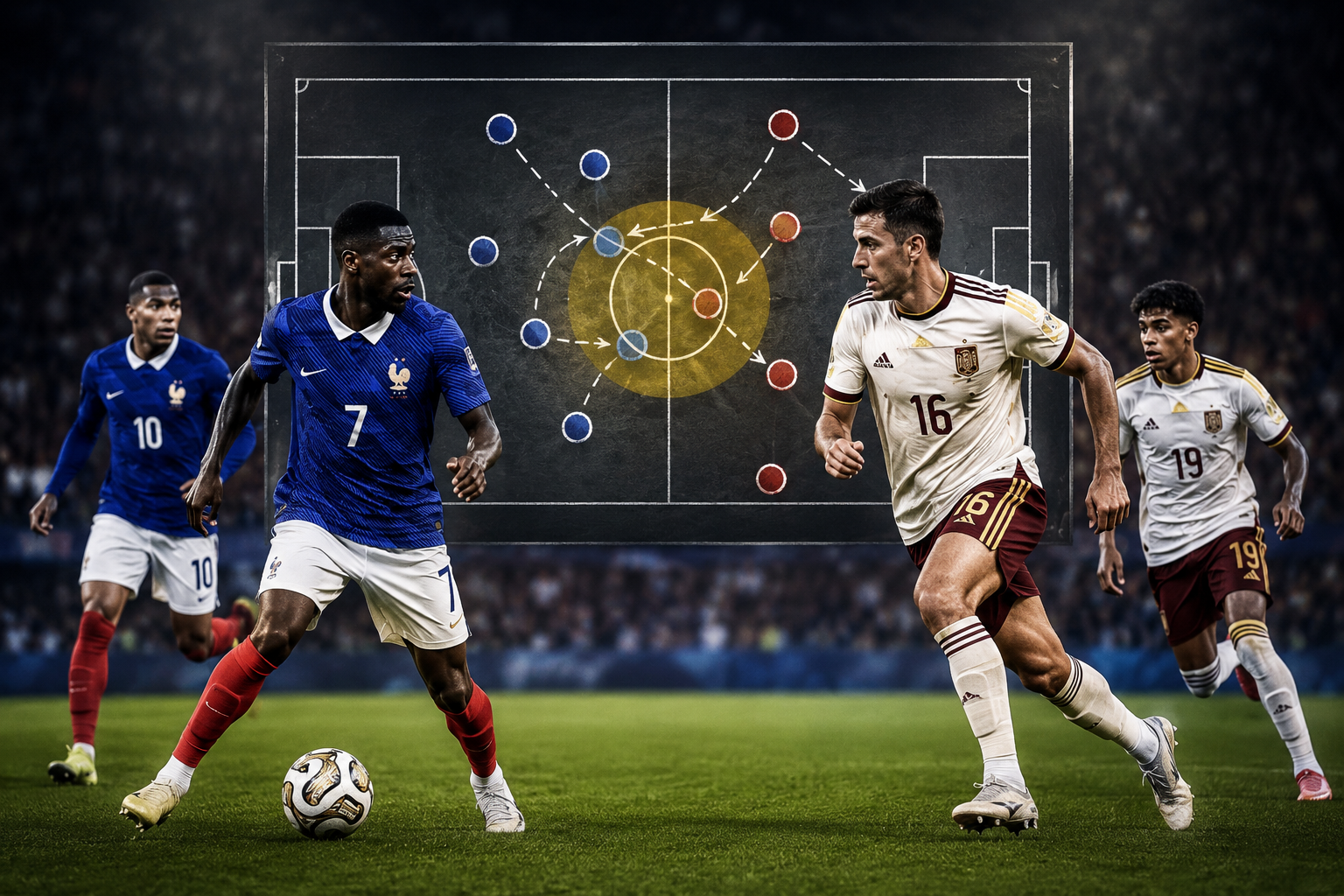
This World Cup semi-final did not merely produce a finalist. Above all, it offered a demonstration of what modern football rewards most: collective control. For ninety minutes, Spain imposed their rhythm, controlled the spaces and dictated the script of a match that France never truly managed to take back into their own hands.
Spanish dominance from the very first minutes
There are defeats that leave regrets. And then there are those that simply force you to acknowledge the opponent's superiority. France's defeat against Spain clearly belongs to this second category.
From kick-off, La Roja imposed their identity. The ball moved quickly, the runs were coordinated, the build-up play was clean. Les Bleus attempted to press, but that press was regularly bypassed by a Spain side that always seemed to have a solution one step ahead.
Very quickly, one man became the focal point of all French concern: Lamine Yamal. The young Spanish winger made life extremely difficult for Lucas Digne. Every touch created an imbalance, every burst of pace forced the French full-back to defend on the back foot. The penalty won by Yamal was not merely the consequence of a lost duel — it rewarded an opening spell in which Spain had already established collective supremacy.
France did not collapse, however. As the first half progressed, Didier Deschamps's men gradually recovered some possession and strung together a few interesting sequences. But this improvement masked a deeper reality: Spain was willing to let the ball go, without ever relinquishing control of the match.
Every time Les Bleus seemed to settle, La Roja immediately took charge again — a perfectly executed build-up, a quick recovery or a long spell of possession was enough to break France's rhythm. The second Spanish goal therefore came as no surprise: it rewarded a side that, without outrageously dominating possession, never stopped controlling the flow of the game.
The real battle was fought in midfield
The goals tell the story of the result. The midfield tells the story of the match. That is where this semi-final was truly decided.
Didier Deschamps maintained his double pivot against a Spanish engine room built around Rodri, Fabián Ruiz and a third player constantly offering a solution between the lines. The result:
- On every Spanish build-up, a player appeared free.
- On every French press, one pass was enough to break the first line.
- On every recovery, La Roja immediately moved forward in the best possible conditions.
France's shortcoming was not a problem of intensity. It was a problem of structure.
Rodri delivered another top-level performance. Without a single spectacular gesture, he dictated the tempo of the match through his positioning, his availability and his remarkable technical precision. Alongside him, Fabián Ruiz arguably produced his most complete performance of the tournament: ever-present in his movement, invaluable in his covering, always available between the lines, he provided that permanent numerical superiority which disorganised the French midfield.
While all eyes were turning to Lamine Yamal or Kylian Mbappé, it was they who were quietly deciding the outcome of the match. It was from their mastery that all of Spain's superiority was born.
Why the French attackers disappeared
This midfield dominance also explains why the French forwards struggled so much. Michael Olise rarely managed to receive the ball in good conditions. Ousmane Dembélé almost never found the spaces he thrives in. Bradley Barcola had very few opportunities to attack in behind.
As for Kylian Mbappé, he tried to provoke, to drop deep and to create individual differences, but found himself too often isolated against a perfectly organised side. The problem did not start in attack — it started much further back.
Didier Deschamps tried to respond by bringing on Theo Hernandez to provide more pace against Lamine Yamal. An understandable adjustment, but one that came when Spain were already leading 2-0 — and above all one that was unable to solve the real problem: Les Bleus still did not control the heart of the game.
La Roja's silent heroes
If Rodri and Fabián Ruiz conducted the performance, Marc Cucurella was its great defensive architect. The Spanish full-back delivered a remarkable display: always well positioned, he produced a series of interceptions and decisive interventions in his own box, winning the majority of his duels against Michael Olise.
His block on a dangerous Kylian Mbappé shot — celebrated with the same energy as a goal — perfectly encapsulates the spirit of this Spain side: defending together, with the same intensity as they attack. This defensive solidarity perfectly complements the mastery displayed in midfield.
What this semi-final says about modern football
In the aftermath of the match, many will remember Lamine Yamal's bursts of pace, Lucas Digne's difficulties or Spain's clinical edge. They will not be wrong. But they risk missing the essential point.
Spain did not win because they had more of the ball. They won because they always knew what to do with it.
Modern football no longer simply rewards teams that monopolise possession. It rewards those who know how to control a match — the tempo, the spaces and the key moments — with maturity and collective cohesion.
On Tuesday evening, Rodri and Fabián Ruiz gave a masterclass in midfield control. And it was there, far more than in either penalty area, that Spain built their place in the final.


Comments
By posting, you agree to our privacy policy.