
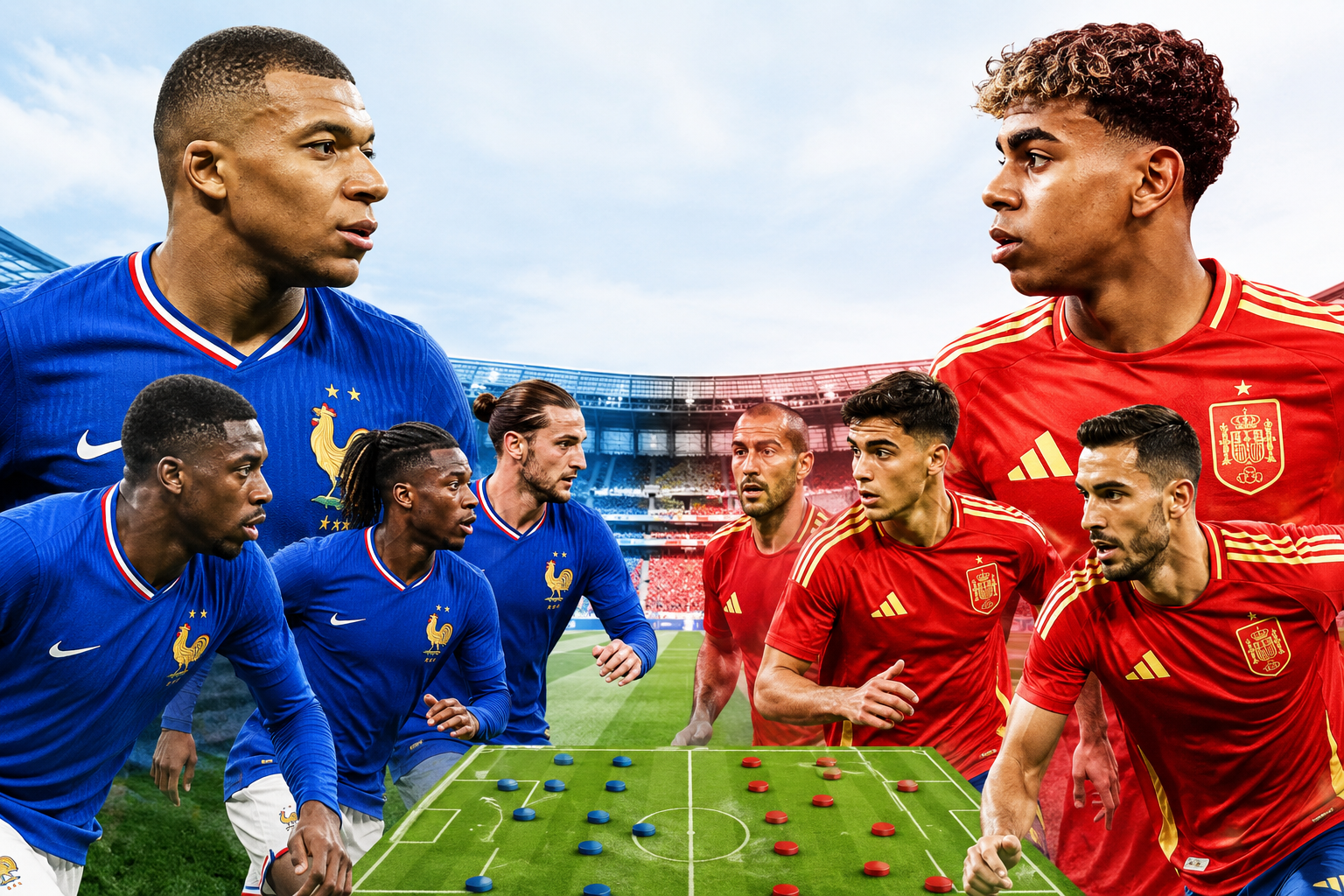
Tuesday evening in Dallas, more than just a place in the World Cup final will be at stake. France and Spain meet for a third clash in two years. Having lost at Euro 2024 (2-1) and then in a spectacular 5-4 in the Nations League, Les Bleus face a Roja that has gained a slight psychological edge in this recent rivalry.
But this semi-final goes far beyond the spirit of revenge. It pits two of the tournament's most convincing teams against each other: two teams that win, but who do not seek to win in the same way.
Two philosophies, one shared ambition
Since the start of the World Cup, Didier Deschamps has built his campaign with great intelligence. His France side have never given the impression of following a single plan: they know how to accelerate when the game opens up, drop deeper when the context demands it, and press high when the opportunity arises.
The quarter-final against Morocco is probably the best illustration of this. Driven by an ever-present Manu Koné in ball recovery and by perfectly coordinated pressing, the French smothered the Atlas Lions from the very first minutes. Thirteen shots against just one in the first half, quick ball recovery and a dominance that was never really called into question.
This team no longer relies solely on Kylian Mbappé. The France captain leads the top scorers chart with eight goals, but he is now supported by a rejuvenated Ousmane Dembélé, who has scored five goals, and by Michael Olise, who has become the tournament's leading assist provider with five assists. Three different profiles that make the French attack far less predictable.
A Spain faithful to its principles… but capable of adapting
On the other side, Luis de la Fuente has never abandoned his identity. Build from the back, keep possession, press immediately after losing the ball, and wait until a space appears: such is the Roja's blueprint.
Against Belgium, this philosophy was once again applied without haste. Faced with a very compact block, Spain continued to circulate the ball until finding the breakthrough through Mikel Merino late in the game.
But this Spain is not rigid. While Rodri remains the true metronome of the team, De la Fuente does not hesitate to adapt the profiles around him according to the needs of the match.
- Pedri brings his ability to break lines with his passing and accelerate play between spaces.
- Fabián Ruiz offers more projection and balance in both penalty areas.
- Dani Olmo operates between the lines to provide creativity.
- Mikel Merino has established himself as a valuable weapon in the closing stages of matches, thanks to his physical impact and eye for goal.
Spain does not change its philosophy. It changes the tools with which it applies it.
The midfield battle could decide the match
There will be much talk of Mbappé against Yamal. Yet the real contest will undoubtedly take place in the heart of the pitch. Rodri will look to set the tempo. Around him, Pedri, Fabián Ruiz or Dani Olmo will attempt to provide the necessary solutions to bypass the French press and maintain possession.
Facing them, Deschamps is expected to stick with the Adrien Rabiot – Manu Koné partnership, whose complementarity has contributed greatly to France's balance since the round of sixteen. But one question remains: will the manager commit to fielding just two central midfielders against a Spain side that most often operates with three players capable of controlling that zone?
If France wins the ball high up the pitch, as they did against Morocco, Mbappé, Dembélé and Olise will immediately have space to attack a Spanish defence that has shown a few signs of vulnerability against Portugal and then Belgium. Conversely, if Rodri and his teammates manage to establish their passing game, Les Bleus could spend much of the match defending without the ball.
The Warren Zaïre-Emery card
In this tactical reflection, one player could have a decisive role: Warren Zaïre-Emery. The young French midfielder may not be guaranteed a starting place, but his profile offers Deschamps a different option. His intensity, his running volume and his ability to repeat efforts make him an ideal weapon to disrupt the Spanish game.
If he comes on during the match, he could bring exactly what is sometimes missing against a team that monopolises the ball: energy, counter-pressing and the ability to break the rhythm imposed by Rodri and his teammates. In a semi-final where every detail will matter, this option could carry significant weight.
Tempo versus verticality
At its core, this semi-final pits two visions of football against each other. France looks to hurt quickly, exploiting the pace of their attackers and the quality of their transitions. Spain prefers to control time, tire their opponents through possession and patiently create the imbalance.
The key may not lie in knowing who has the ball more. It will lie in knowing who makes the best use of the few seconds following its recovery. If Les Bleus win the ball high, they probably possess the sharpest weapons in the tournament to punish the slightest Spanish error. If La Roja establishes Rodri, Pedri and Fabián Ruiz in their cruising rhythm, they will dictate the tempo and steer the match towards the scenario they are looking for.
There will be much talk of Mbappé, Yamal or Dembélé. Yet the first ticket to the final could well be earned elsewhere: in that silent battle in midfield, where the rhythm of a great match is so often decided.

Comments
By posting, you agree to our privacy policy.