
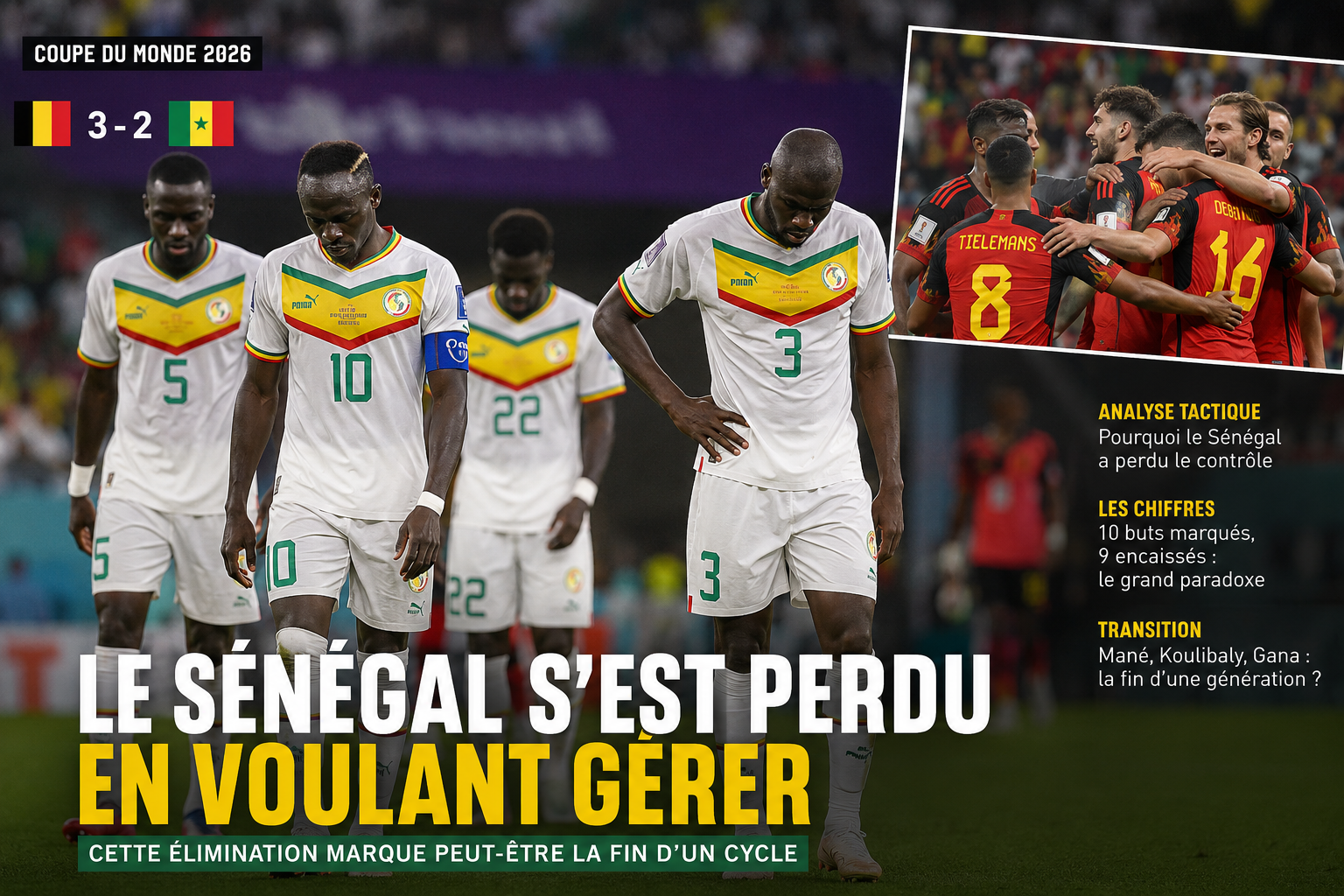
For 85 minutes, Senegal had done almost everything right. Up against a long-toothless Belgium, the Lions controlled the game: more precise technically, more aggressive in duels, capable of keeping the ball and building out cleanly, they seemed to have taken the measure of an opponent who had nonetheless been billed as favourites.
Then everything collapsed. Within a matter of minutes, a team brimming with confidence became jittery. The build-up play disappeared, the defensive block dropped deeper, the lines stretched — and Belgium rediscovered a confidence they had seemed to have lost.
At the final whistle, Rudi Garcia suggested that Senegal had 'lost their tactical structure' towards the end of the match. The observation is fair. His interpretation, however, deserves some nuance.
A team that played against its own nature
Contrary to what the Belgian manager implied, this Senegal side is not a team that builds its success by sitting deep or shutting games down. Under Pape Thiaw, the Lions have developed an ambitious style of football, capable of holding the ball, pressing high and unsettling European sides. The victories against England and Brazil in preparation had confirmed this evolution.
The paradox is therefore striking. At 2-0, Senegal stopped doing what had made them superior: clearances replaced possession sequences, the press disappeared, and Belgium gradually imposed their game.
The Lions did not lose because they wanted to keep attacking. They lost because they tried to manage a lead they had never sought to manage before.
A coaching performance that raises questions
It would, however, be reductive to place all the responsibility on Pape Thiaw. For more than an hour, his game plan had worked perfectly: the starting selections were coherent and the substitutions also reflected a physical reality. Pape Gueye, heavily involved in midfield, left the pitch as early as the 67th minute after an enormous workload.
On the other hand, the bench did not deliver what might have been expected of it. Neither the technical composure to hold the ball, nor the personality to slow the tempo, nor the impact to push back an increasingly adventurous Belgium. This is probably one of the key lessons of this elimination.
A World Cup full of paradoxes
The statistical balance sheet perfectly sums up the Lions' tournament. Senegal finish this World Cup with 10 goals scored, a record for an African nation in a single edition. But also 9 goals conceded.
For years, defensive solidity was this team's hallmark. This time, individual errors multiplied, key players put in more inconsistent performances than usual, and goalkeeper Mory Diaw never managed to provide the composure needed in the most tense moments. This defensive fragility is undoubtedly the main explanation for such a brutal elimination.
A transition more difficult than expected
Beyond this defeat, it may be an entire generation that is reaching the end of its story. For more than a decade, Senegal has relied on leaders such as Sadio Mané, Kalidou Koulibaly and Idrissa Gana Gueye. They gave the country its first continental title and established the Lions among the best African nations.
For Sadio Mané, who had already hinted in recent months that the end of his international adventure was approaching, this match could carry a particular significance — even if no official announcement has been made. For Koulibaly and Gana Gueye, the future also remains uncertain.
The next generation exists. The talent too. But this World Cup showed that this new generation was not yet ready to carry the team alone. On the pitch, they sometimes lacked maturity in decisive moments. Off it, the tensions that emerged around the staff, certain players' posts on social media, and the various hiccups surrounding the delegation offered a glimpse of a group still under construction.
To this is now added the question of Pape Thiaw's future. While the Federation has not yet spoken, part of the Senegalese press is already calling for his departure, while supporters question his ability to lead this transition. More worrying still, the first cracks appear to be emerging within the dressing room, with public criticism directed at the technical staff.
Rebuilding without losing one's way
Senegal lacks neither talent nor a future. However, they are entering the most delicate period a great national team can face: the one in which a golden generation must be replaced without losing the team's identity.
The real challenge for Pape Thiaw — if he remains in post — will not simply be to rebuild a squad. It will be to transform a promising group into a generation capable of shouldering the legacy left by Sadio Mané, Kalidou Koulibaly and Idrissa Gana Gueye.
Because great teams do not die after an elimination. They reinvent themselves. That is now the defining challenge facing Senegalese football.

Comments
By posting, you agree to our privacy policy.