
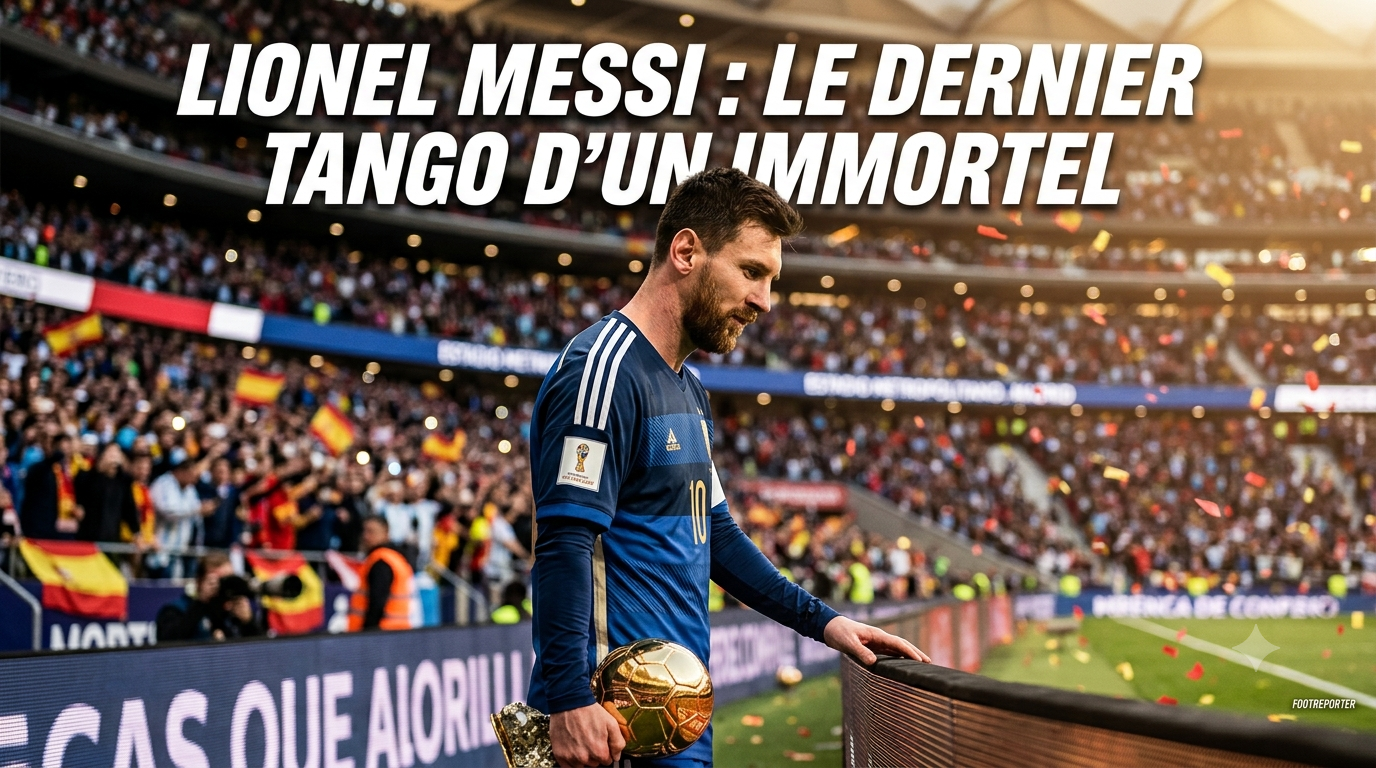
This day had to come eventually. Even legends put away their boots. Tonight, Lionel Messi played what looks like his last ever World Cup match. A final lost to a stronger Spain, but one that changes nothing about what truly matters: football has just closed the most beautiful chapter in its modern history.
For nearly twenty years, Messi did not simply accumulate trophies. He changed the way we look at the game.
From the boy from Rosario to the king of football
We watched him arrive as a teenager in Barcelona — shy, slight, almost fragile. We watched him become the best dribbler of his generation, then the best passer, then the best goalscorer. Each year, he found a new way to push the boundaries.
Defenders fouled him. Managers devised every plan imaginable to stop him. None ever truly found the answer. Messi did not run faster than the others. He simply thought before them.
The emptiness of 2014, the rebirth of 2022
His international career could have remained one of immense frustration. The final lost to Germany in 2014, the Copa América defeats, the repeated criticism, the announcement of his international retirement in 2016 before his return just weeks later: everything seemed determined to deny him the ultimate consecration.
Then everything changed. The 2021 Copa América, the Finalissima, and above all that world title in Qatar in 2022, arguably the greatest final in football history. That trophy gave him something no statistic could ever provide: peace. From that moment on, Messi was no longer playing to convince anyone. He was playing to pass something on.
One last dance at 39
Many thought he would not even be present in 2026. Yet the Argentine captain guided his team to the final once more. His influence was no longer that of a player churning out sprints — it was that of a master who slows down time.
- A pass slipped between two lines.
- A perfectly weighted first touch.
- A glance that anticipates.
- A movement that creates space.
Messi reminded us every night that football is, above all, a game of intelligence. Before this final, the message he had posted on social media already read like a farewell: he spoke of 'the last tango', suggesting that this World Cup would likely be the last of his international career. (TNT Sports)
The final that symbolises the passing of the torch
The image will endure. On one side, Messi, the man who dominated two decades. On the other, Lamine Yamal, symbol of a new generation ready to take over.
Argentina fell to a Spain that was collectively superior, dominant in their play, capable of controlling the match for the vast majority of normal time. Ferran Torres ultimately delivered the title to La Roja in extra time. (AP News)
Football is like that: kings never truly lose. They pass on their crown.
More than a trophy cabinet
- Eight Ballon d'Or awards.
- World champion.
- Olympic champion.
- Copa América winner.
- Four Champions League titles.
- Hundreds of goals and assists.
Reducing Messi to a list of trophies would, however, be almost disrespectful to him. His true legacy lies elsewhere: he proved that talent could overcome power, that creativity could dominate athleticism, that a quiet boy could become the most admired sporting icon of his generation.
Thank you, Leo
Football will go on. Yamal, Mbappé, Haaland and others will write their own stories. But there will always be a before and after Lionel Messi. Because some players win World Cups. Others win the hearts of supporters. Messi will have achieved both.
And when children one day ask why so many people still talk about that Argentine number 10, only one answer will be needed:
'You never saw Messi play. We did.'

Comments
By posting, you agree to our privacy policy.