
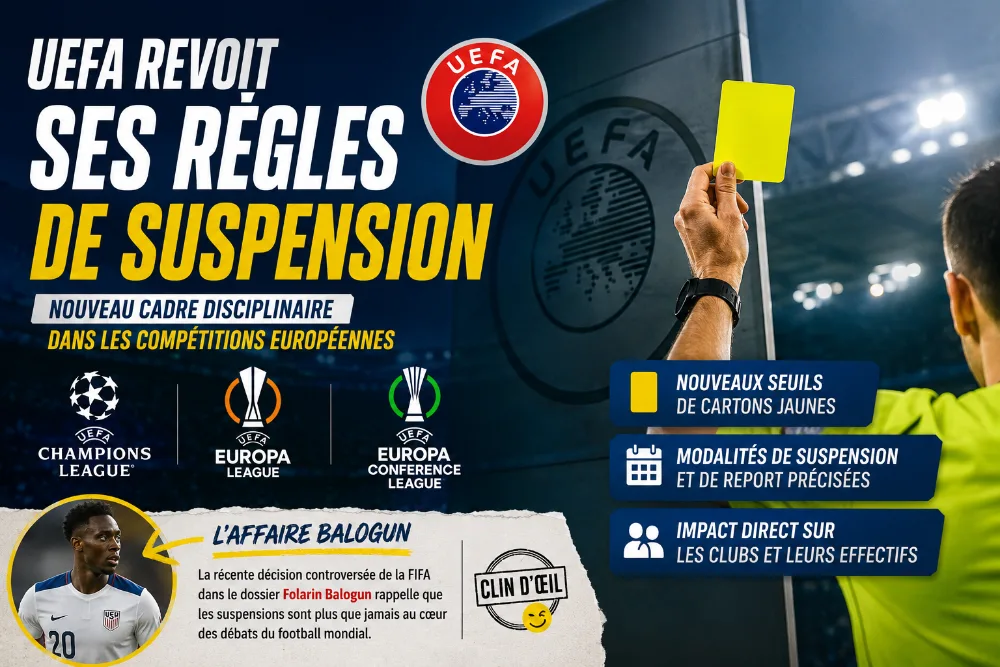
UEFA has officially confirmed an update to its disciplinary regulations for its European competitions. Clubs competing in the Champions League, the Europa League and the Europa Conference League will now have to navigate a more precisely defined framework regarding suspensions and the management of bookings. These adjustments directly affect coaches, players and administrative staff, who will need to anticipate every disciplinary scenario as the season unfolds.
Clearer rules on yellow cards
The main change concerns the accumulation of bookings. From now on, a player or a member of staff will be suspended upon receiving three yellow cards, and then again after the fifth, the seventh, the ninth, and so on. This provision aims to better regulate disciplinary monitoring throughout the competition.
Another notable point: yellow cards will be wiped after the quarter-finals. In practice, no player will be able to miss a semi-final or a final due to a simple accumulation of bookings. However, a red card will always result in an automatic suspension for the following match, with UEFA's disciplinary commission retaining the ability to increase the sanction depending on the severity of the offence.
The Balogun case, a reminder of a disciplinary climate under tension
This development comes at a time when disciplinary matters occupy a particular place in football news. Without any direct link to the UEFA reform, the Folarin Balogun case — whose suspension was lifted by FIFA following a widely discussed sequence of events — illustrated just how quickly disciplinary decisions can go beyond the sporting sphere to fuel a much broader debate. Further proof that regulations and their terms of application are now being scrutinised as never before.
A strategic issue for clubs
For teams competing on the continental stage, these regulatory clarifications will have a tangible impact on squad management. Coaches will need to keep a close eye on the accumulation of bookings in order to avoid depriving their team of a key player at a decisive moment. Administrative staff, for their part, will need to have a thorough command of these new provisions to prevent any management errors.
At a time when European competitions are often decided by fine margins, an in-depth knowledge of the regulations represents a genuine competitive advantage. Between sporting strategy and administrative rigour, UEFA's new rules serve as a reminder that continental success is also built off the pitch.





Comments
By posting, you agree to our privacy policy.