
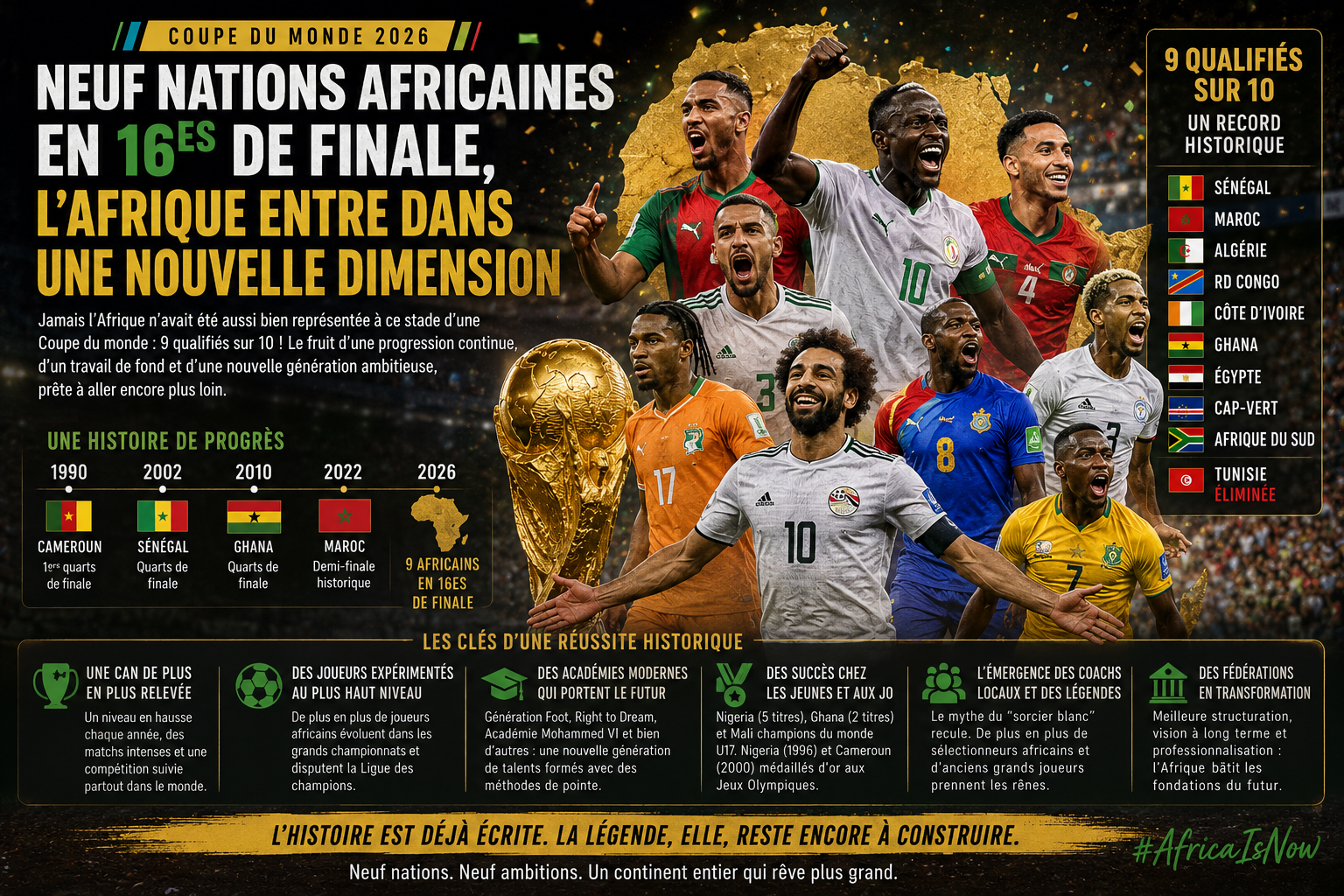
This is no miracle. This is no stroke of luck. By qualifying nine of its ten representatives for the round of 16 at the 2026 World Cup, Africa has produced the greatest performance in its history. A record that rewards nearly forty years of continuous progress, from Cameroon's exploits in 1990 to Morocco's run to the semi-finals in 2022.
Nine African nations will be present when the knockout stage gets under way. Never before had the continent been so well represented at this stage of the competition. But reducing this performance to a mere statistic would be a mistake: this World Cup confirms a deep-rooted trend. African football has entered a new era.
A progression that did not begin yesterday
The narrative that Morocco alone paved the way is incomplete. The story had begun long before, and it is written in several chapters.
- In 1990, Roger Milla's Cameroon became the first African side to reach the quarter-finals of a World Cup.
- Twelve years later, Senegal achieved the same feat at their very first World Cup, eliminating France, the reigning world champions, along the way.
- In 2010, Ghana came within inches of a historic semi-final, denied their date with destiny by Luis Suárez's handball and a penalty shootout that has since been etched into collective memory.
- In 2022, Morocco became the first African representative to reach the last four of a World Cup.
This history is therefore not one of sudden breaks. It traces a curve of continuous progression, and the 2026 World Cup offers fresh proof that this evolution now concerns an entire continent.
The reasons behind a rise to prominence
AFCON, a school of the very highest level
Long perceived as an unpredictable competition, the Africa Cup of Nations is today one of the most demanding tournaments in international football. The gaps between Africa's leading nations narrow year after year, and each edition demands matches of intense tactical and physical rigour, where individual talent alone is no longer enough.
This demanding environment shapes players who are accustomed to performing under pressure long before they arrive at a World Cup.
Players hardened by experience at Europe's top clubs
Almost the entire pool of African squad players now compete in the biggest European leagues. Many regularly feature in the Champions League or other continental competitions. The gap that once existed with European national teams has narrowed considerably.
African players no longer arrive at major tournaments to discover what the elite level feels like. They live it every week.
Academies finally reaping their rewards
This success is also the success of development centres. Over the past twenty years, African academies have profoundly modernised their working methods. From Senegal to Morocco, from Ivory Coast to Ghana, they now produce players capable of joining the best European clubs at a very young age while retaining a clearly defined footballing identity.
Africa is no longer producing only exceptional individual talents. It is producing complete generations.
Youth successes, a fertile breeding ground
Today's performances also have their roots in youth football. Nigeria, Ghana and Mali have all won U17 World Cups. On the Olympic stage, Nigeria in 1996 and then Cameroon in 2000 had already demonstrated that African sides were capable of claiming the greatest international titles.
The current generation did not appear from nowhere. It is the heir to work begun several decades ago.
The gradual end of the 'white wizard'
For a long time, success for an African national team seemed to depend almost inevitably on a European head coach. That idea is gradually losing ground. More and more federations are investing in their own technical staff, while integrating former internationals into coaching staffs, sporting directorates and federation governing bodies.
The model is not uniform — several teams continue to achieve results with foreign coaches — but the notion that only expertise imported from Europe can lead to success loses ground with every edition.
The hardest part begins now
The record is already historic. But it may be only a stepping stone. For the real challenge now is to convert this massive presence into memorable runs. The round of 16 fixtures give a clear sense of what is at stake:
- Senegal – Belgium
- Morocco – Netherlands
- DR Congo – England
- Algeria – Switzerland
- Ghana – Colombia
- Cape Verde – Argentina
- Ivory Coast – Norway
- Egypt – Australia
- South Africa – Canada
Fixtures that would once have seemed unbalanced. Today, they look wide open. And that, perhaps, is the true revolution: Africa no longer participates in the World Cup simply to spring a surprise once every ten years.



Comments
By posting, you agree to our privacy policy.