
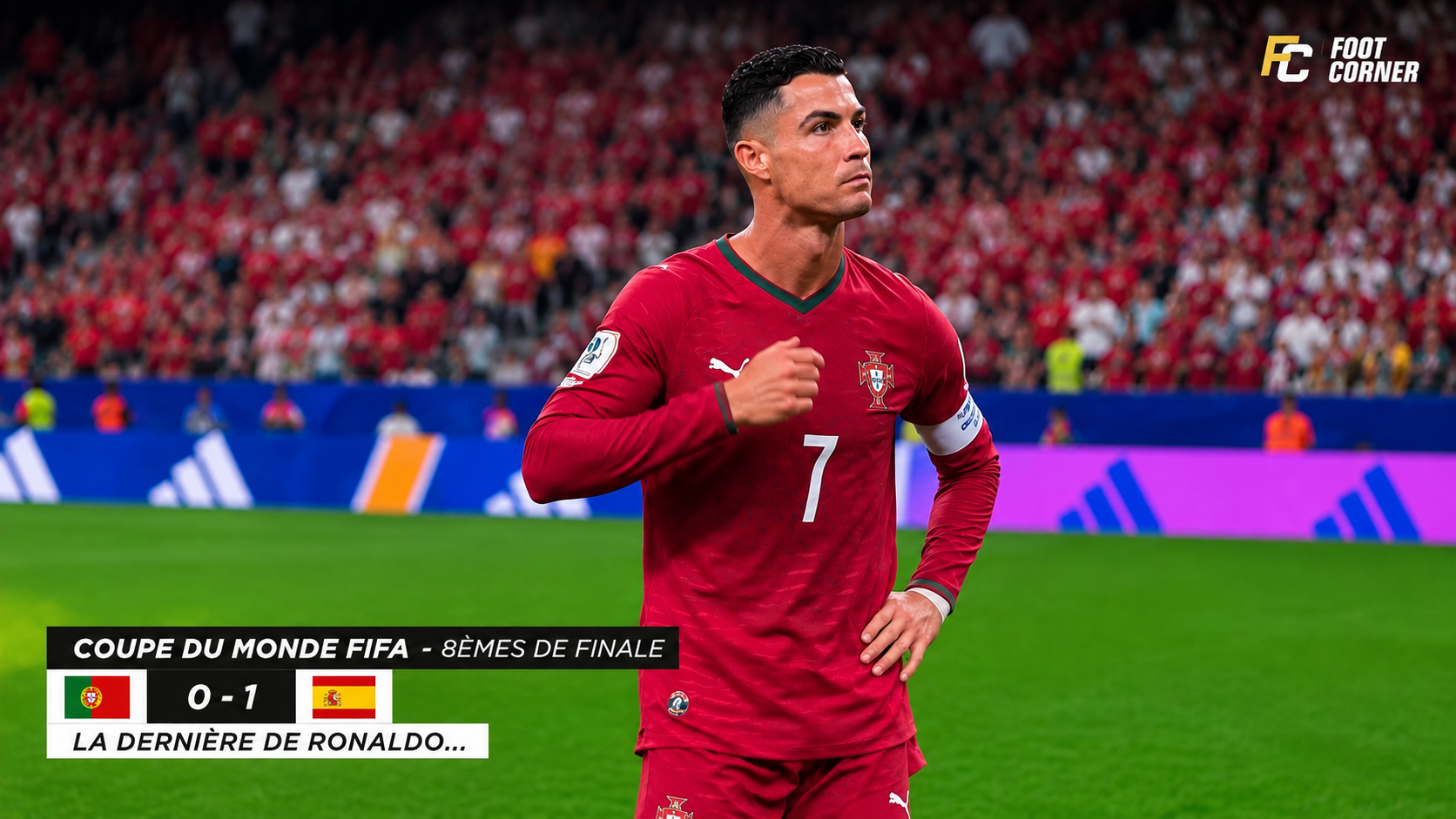
The curtain may have fallen on one of the greatest careers football has ever seen. Beaten by Spain (1-0) in the round of 16 of the 2026 World Cup, Portugal exits the tournament prematurely and, with it, most likely the last World Cup dream of Cristiano Ronaldo.
The image is powerful. The Portuguese captain, his gaze fixed on nothing, seems to weigh the full burden of an extraordinary career that is nonetheless missing one trophy: the World Cup. To reduce this elimination to a simple individual failure would, however, be a mistake. For the real paradox lies elsewhere.
Portugal has never had so much talent
For a long time, one argument kept coming up: Ronaldo was alone, or nearly so. Those days are gone. Never before had Portugal fielded a squad so deep, so complete, and so technically gifted.
- Diogo Costa in goal
- Rúben Dias, defensive cornerstone
- Nuno Mendes and his relentless runs forward
- Vitinha, João Neves, Bruno Fernandes and Bernardo Silva in midfield
- Rafael Leão and Francisco Conceição for attacking thrust
On paper, few national teams can boast such depth. For many observers, this generation is even the most talented in the history of Portuguese football.
So why this feeling of unfinished business?
Because talent never guarantees trophies. For nearly twenty years, Portugal has regularly established itself among the world's best nations without managing to clear the final hurdle. Euro 2016 and the two Nations League titles proved that this side knows how to win. But the World Cup remains a mountain the Portuguese have never managed to climb.
This elimination against Spain may be the most frustrating of all. For unlike previous generations, this one seemed to bring together every quality: experience, youth, technique, bench depth and defensive solidity.
The Portuguese paradox
Portugal often dominates possession and controls the tempo of matches. They produce attractive football, sometimes even exhilarating football. But in knockout games, they sometimes lack the ability to tip a match on an individual flash of brilliance or a moment of collective daring.
Against Spain, the Portuguese kept the ball for long periods without truly unsettling a perfectly organised defence. La Roja, by contrast, once again demonstrated that collective maturity which makes the difference in major competitions.
The fate of Cristiano Ronaldo
There is a certain cruelty to this story. Ronaldo will have lived through several Portuguese generations: the early ones, courageous but limited; the subsequent ones, more ambitious; and this latest one, arguably the strongest of all. Yet it is with this generation — the one that finally seemed capable of going all the way — that his World Cup adventure comes to an end.
His international trophy cabinet will remain immense: European champion, double Nations League winner, five-time Ballon d'Or, all-time top scorer for the national team and one of the greatest players of all time. But the World Cup will continue to occupy a unique place in that record.
A legacy that goes beyond trophies
Should we judge Cristiano Ronaldo's international career solely on the basis of that one absence? Probably not. The Portuguese captain has profoundly changed the stature of his country's football, inspiring an entire generation of players who now perform at the biggest clubs in Europe.
His greatest legacy may not be a trophy. It is having transformed a side capable of pulling off an upset into a nation that every opponent now respects as a credible title contender.
Portugal will have to write the next chapter without their number 7. With a generation that is still young, the talent is still there. The question remains whether Ronaldo's successors will succeed where even the greatest player in their history was never able to triumph: giving Portugal its first World Cup.


Comments
By posting, you agree to our privacy policy.