
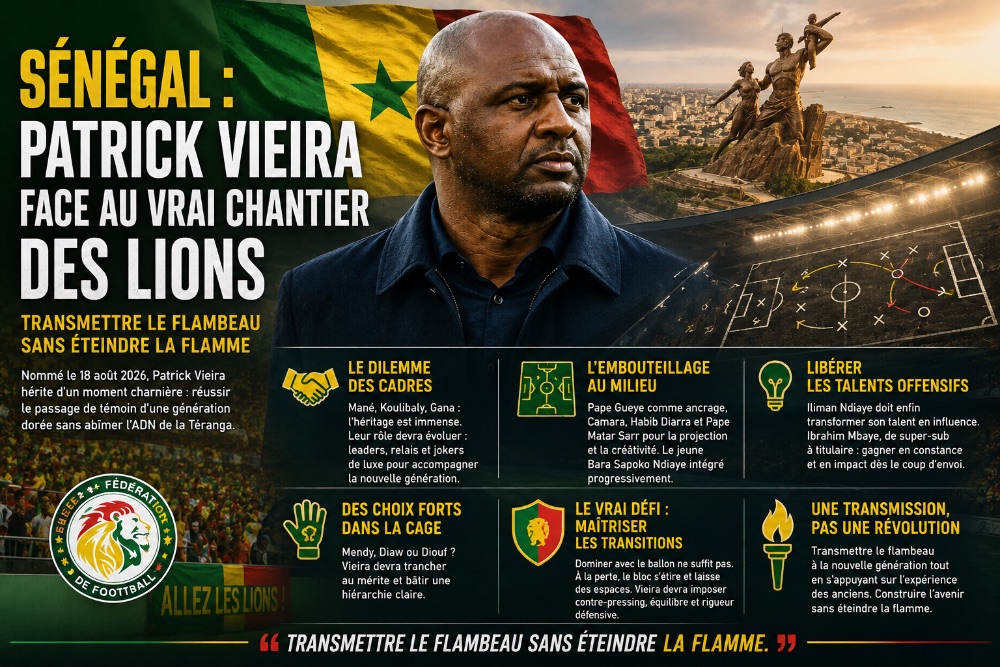
Patrick Vieira is not arriving in Dakar to prove himself or simply succeed Pape Thiaw. Officially confirmed on 18 August by the FSF in the wake of the 2026 World Cup, the local-born coach, raised in Dakar, inherits a pivotal moment: managing the handover of a golden generation without damaging the Teranga's DNA.
The dilemma over senior players: transition or rupture?
The legacy is immense. Sadio Mané, Kalidou Koulibaly and Idrissa Gana Gueye won the AFCON and firmly established Senegal among the great nations of African football.
Brutally sidelining them would be a mistake. Keeping them on automatically out of habit would be another.
Vieira's first challenge will therefore be to redefine their place. Starters, substitutes, dressing-room leaders or mentors for the new generation: the right approach could be a gradual transition rather than a clean break.
Senegal has no reason to discard its past. It must learn to use it to build what comes next.
The strategic logjam in midfield
This is the richest sector and probably the trickiest to balance.
Pape Gueye has the profile to become an anchor point in front of the defence, capable of securing possession and protecting his backline.
Around him, competition is fierce. Lamine Camara, Habib Diarra and Pape Matar Sarr offer different profiles: forward runs, work rate, line-breaking ability and playing volume.
And behind them comes Bara Sapoko Ndiaye, a young midfielder whose integration will need to be gradual. Vieira will have to give him playing time without immediately asking him to carry the Senegalese midfield.
The real challenge, then, will not be picking three names. It will be building a complementary midfield.
Unlocking the attacking talents
Iliman Ndiaye is another major project. His talent no longer needs proving. But his influence with the Lions is not yet living up to what his potential suggests.
Vieira will need to define a clear role for him: a free player between the lines or a wide operator. The goal will be simple: turn his creativity and dribbling ability into a regular influence on matches.
The same question applies to Ibrahim Mbaye.
The young Paris Saint-Germain player has shown he can do real damage when he comes on as a substitute. But the ‘super-sub' label cannot become a permanent tag. Vieira will gradually need to determine whether he can also be a starting option in big matches.
Strong choices in goal
The goalkeeping hierarchy will also be revealing of the new cycle.
- Édouard Mendy
- Mory Diaw
- Yehvann Diouf
These three players offer different options. Vieira will have to establish a sporting hierarchy, based on current form and the project he wants to build, without being constrained by the weight of the past.
Here too, the message will need to be clear: status in the national team is earned on the pitch.
The real challenge: mastering transitions
This is perhaps the most important tactical project.
Senegal know how to keep the ball. The Lions can dominate possession, push their block high and force their opponents back.
But this dominance has a weakness: losing the ball.
When the block pushes up, the team can find itself stretched. The midfielders are sometimes too far from the defence, and spaces immediately open up behind the midfield during opposition transitions.
This is particularly problematic against big teams capable of breaking out quickly under pressure.
Vieira will therefore need to answer an essential question: how can Senegal keep dominating without putting themselves in danger?
The issue is not simply about teaching the Lions to attack. They already know how to do that.
Above all, they will need to improve their counter-press, defensive balance and protection of the central axis.
A handover, not a revolution
Patrick Vieira does not need to lead a revolution.
He needs to achieve a successful handover.
Pass the torch to Lamine Camara, Habib Diarra, Pape Matar Sarr, Pape Gueye, Iliman Ndiaye, Ibrahim Mbaye and those coming through, while allowing the veterans to pass on their experience for as long as they can still be useful.
And above all, give Senegal a more coherent identity: a team capable of dominating with the ball, but also of controlling what happens when it loses it.
Pass the torch without putting out the flame.

Comments
By posting, you agree to our privacy policy.