
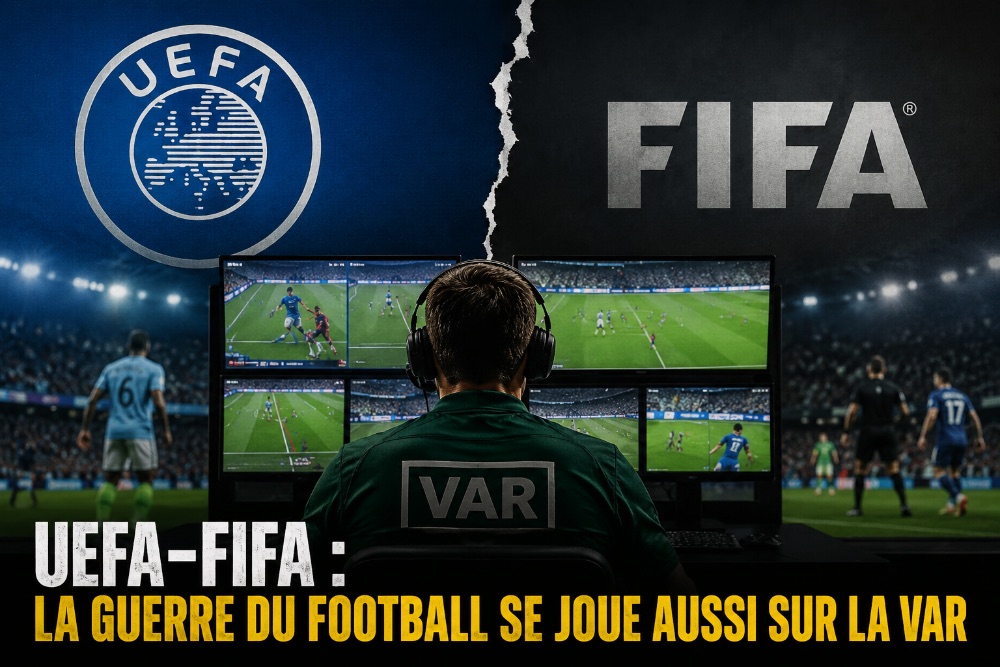
The war between UEFA and FIFA is no longer fought solely over governance, money or the fixture calendar. It has now reached refereeing. Against a backdrop of particularly heightened tensions between the two bodies, UEFA has just launched Clear Line, a platform designed to establish a clear doctrine on the use of VAR.
The principle is straightforward: more than 150 refereeing situations are catalogued, accompanied by footage and explanations to clarify when video intervention should occur — and when it should stay silent.
A political message behind the educational tool
Behind this library of situations, the message from Roberto Rosetti is decidedly political. The head of European refereeing intends to return to VAR's original philosophy: correcting clear and obvious errors, not re-refereeing matches.
'It's football, not PlayStation.'
Rosetti is thus targeting endless analyses and pixel-by-pixel checks. For UEFA, technology must remain a safety net — not a pretext for turning every contact or every duel into a new refereeing inquiry.
A rift with FIFA
The context gives this initiative a particular resonance. For several weeks, the conflict between UEFA and FIFA has hardened, notably around Gianni Infantino's projects and global football governance. UEFA even maintained, at the start of August, its threat to boycott certain FIFA competitions.
In this climate, asserting a European doctrine on VAR is far from trivial. UEFA advocates a vision where the referee remains central and technology only intervenes as a last resort — an approach that stands in contrast to the trend of expanding video use observed in recent international competitions. Clear Line thus becomes more than a simple educational tool: it is the assertion of a European standard for refereeing.
Knowing when to stop
The problem with VAR is no longer its ability to uncover a mistake. Current technologies make it possible to review almost every action from multiple angles and in slow motion. The real question lies elsewhere: when should the search stop?
A contact always looks more serious in slow motion. A handball can be interpreted differently depending on the angle. An offside sometimes comes down to a matter of centimetres. UEFA wants to draw a line: not every error warrants a video intervention.
In France, Ligue 2 will moreover remain without VAR for the 2026-2027 season, while the Refereeing Directorate is multiplying educational initiatives in Ligue 1 to explain controversial decisions.
After years of calling for more technology, European football seems to be initiating a reverse movement: learning to use VAR less in order to use it better.


Comments
By posting, you agree to our privacy policy.